Happy holidays, bleeps-
Yes, it's been a while since I have posted on our charitable giving. That's not because we haven't been continuing to give. But, as you have noticed, I'm not blogging as much (who is?). And, I try not to repeat things I have already said once.
But it's time for an update. Over time, things change. We are giving to some new and different organizations. Some because of changes in our family's interests, and some due to a changing world (some of you may feel as concerned as we do about how minorities and the environment will fare following the recent US elections). Recently, a few friends and family members have asked me for my "list". As with all of my posts, I am hoping that it will have some small impact in how you think and what you do. So, here is an updated list showing where we are giving. As in prior years, I say a little about who and why, but not how much. And I try to throw in a few helpful hints, mildly humorous observations and broad encouragement to give what you can to organizations that effectively help others.
I will start with something that seems to be changing. It is worth reflection. It has to do with who supports charities, and in particular, those that support the organizations that work to help the disadvantaged. For many years, studies showed that the poor and middle class gave a higher percentage of their income than the wealthy. And, they tended to support organizations that help the disadvantaged. In comparison, the largest gifts from the wealthy tended to go to universities, museums and hospitals. Things one can put a name on.* But this may be changing. Not so much that the rich are giving more, but that the poor and middle class are giving less. As one article says, "the growth in inequality is mirrored in philanthropy; as wealth concentrates in fewer hands, so does philanthropic giving and power." Don't get me wrong- I am happy to have the wealthy giving to charities of their choice (and giving to universities is good, one in particular!). I just feel that society is healthier if many are giving, rather than few. I am a fan of participatory philanthropy and democratic donations (that's a small "d", folks).
OK, OK, here's the 2016 list:
Health (15% of total):
Doctors w/o Borders (Nobel prize winning org providing care for those who need it most)
Against Malaria (working to prevent malaria; primarily through bed nets)
Watsi (crowd funding health care for those who can't afford it)
Last Mile Health (providing health care in Liberia)
Environment and Conservation (20%):
Nature Conservancy (preserving significant landscapes)
National Park Foundation (helping support national parks, since government funding falls short)
IdeaWild (small grants to wildlife conservationists)
350.org (climate change activism)
CSU Center For Collaborative Conservation (long term conservation through collaboration)
NRDC (sometimes, we need to play defense)
Wilderness Society ("in wildness is the preservation of...")
Outdoor Alliance (access to public lands for human powered recreation)
Social Justice/Community Development (25%):
One Acre Fund (helping farmers grow their families out of poverty)
Women for Women Intl (helping women in conflict affected regions)
Mission Continues (volunteering for veterans)
Anera (supporting poor communities in Gaza, West Bank)
ACLU Foundation (protecting our constitutional rights)
Sylvia Rivera Law Project (GLBT civil rights and legal support)
MALDEF (Latino civil rights)
International Rescue Committee (refugee assistance)
Planned Parenthood (women's health and family planning)
Education (10%)
Intercambio (cultural integration and language for immigrants)
10.10.10 (entrepreneurs tackling wicked problems)
CSU Global Social Sustainable Enterprise MBA (check it out, it's tremendous)
Independent Journalism/Research (10%)
High Country News (news about the Western US)
Pro Publica (investigative journalism in the public interest)
Grist (environmental reporting)
Colorado Public Radio (NPR, plus great local reporting)
Union of Concerned Scientists (because science doesn't care what you believe)
Local (20%)
SAINT (transportation for seniors in Fort Collins)
Food Bank of Larimer County
One22 (community services in Jackson)
Community Safety Network (shelter in Jackson)
I hope this list will give you some ideas of what you might like to support this year.
If you wanted my idea for one organization where even a small gift would make a difference, I'd suggest Watsi. Your entire donation goes to life changing health care for someone who needs it. I have been involved in the organization for several years and continue to be impressed by their work.
_________________
*Much has been written about the motivations for giving. I have said my piece here.
Wednesday, December 07, 2016
'Tis the Season: Charity 2016

Tuesday, October 11, 2016
A New Geography of Hope?
The following is derived from an introduction I gave for Marjorie Kelly, who was a keynote speaker and guest at the annual convening of the Intermountain West Funders Network (IMWFN) this spring.
****************
Good morning and welcome to our annual convening. The website says "the Intermountain West Funder Network is a unique opportunity for funders to join together to engage residents in strengthening their communities, supporting research and learning, and building a philanthropic community that will leverage funding and support for one of the nation’s most iconic and fastest-growing regions.”
In Stephen Marglin's wonderful book- The Dismal Science- How Thinking Like an Economist Undermines Community" he says:
“economics relies on value judgments implicit in foundational assumptions about the self-interested individual, about rational calculation, about unlimited wants, and about the nation-state, and it is these assumptions that make community invisible. In arguing for the market, economics legitimizes the destruction of community and thus helps to construct a world in which community struggles for survival.”This group comes from, and is based in, a place called the "Intermountain West." As our website says, it is "iconic and fast growing" and this creates unique challenges for building communities. Just as there are aspects of markets that undermine community, there are aspects of our "Westerness" that exacerbate this problem. One of my favorite writers, Wallace Stegner, is famous for his line that the West’s wilderness is “the geography of hope” for America. As he got older, Stegner became increasingly uncomfortable with this view, and spent much of his writing analyzing the unique social and environmental challenges facing communities in the West:
“Visionary expectation was the great energizer of the westward movement, and something like it still drives the rush to the Sunbelt. But exaggerated, uninformed, unrealistic, greedy expectation has been a prescription for disappointment that the West has carried to the corner drugstore too many times. Ghost towns and dust bowls, like motels, are western inventions. All are reflections of transience, and transience in most of the West has hampered the development of stable, rooted communities and aborted the kind of communal effort that takes in everything from kindergarten to graveyard and involves all kinds and grades and ages of people in a shared past and a promise of continuance.”
Friday, October 10, 2014
How To Be Successful in Life and Business
Get Lean. Lean In. Be disruptive. Move from Good to Great.
There is much written and spoken about success. As a business. As a person. As a country.
Humans like a guiding star, and they take comfort in being told there is a map for their future journey. If you are starting a business, "how to" information is comforting. If you are a company struggling to innovate, "how to" advice is comforting. If you are starting your career as a recent graduate, "how to" information on leadership and career trajectory is comforting.
Many are happy to tell you "how to" be successful. Before rushing to read the next book, sign up for the next seminar or watch the next video posted on Facebook, it might be worthwhile to step back for a minute and ask a question:
Is this "how to" advice descriptive, derivative, prescriptive or predictive?
Descriptive: uses historical information to describe what others* have done. "This is what these successful companies** did."
Derivative: uses descriptive information to derive principles or approaches. "Here is a map that shows what these companies did to be successful." Beware. There may be many other companies that did the same things, but were not successful. No one talks about these or writes best selling books about them.
Prescriptive: uses derivative information to put forward a framework that may be applied to a new situation. "These companies used this map and were successful. You should use this map too."
Predictive: uses prescriptive information and claims correlation/causation in order to propose that those who follow the framework will be successful in a new situation. "If 100 companies use this map, 67% of them will be successful" or "If you use this map you will be successful".
There are many instances where doing what was done before can lead to a successful outcome. Making spaghetti. Opening a barber shop. Driving to work. Making another bottle of beer. In these situations, you may chose to just use prescriptive or predictive approaches, and jump right over the descriptive and derivative.
If you are attempting to do what has never been done before, descriptions may be helpful.*** Derivations, prescriptions and predictions much less so. If they feel comforting, it is a false comfort. The map is wrong.
If you want to be successful in leading a life or starting a business that has been done before, I can be prescriptive (and even predictive)- just follow the maps of others. If you want to be successful in something truly new and different, I can suggest that you treat those maps as where not to go.
________________________
* There is a sub-genre. Business biographies describing "what I did to be successful." 'nuf said.
** These days: Google, Apple, Facebook. Not so long ago: Intel, Microsoft, Nokia. A little longer ago: Xerox, Gillette, Phillip Morris. Just by looking at these companies, you can also begin to question just what success is. If so, please pause and reflect about your purpose.
*** Helpful in two ways: i) it helps build your expertise to know the history of a field/industry; ii) you may learn from others experience (as long as you recognize these are limited to their circumstances and may be filled by the biases of those relaying the information). For instance, Randy Komisar's ideas on using analogs and antilogs can be helpful ways to analyze descriptive information in your field (recognize they are derivative, and may be of limited predictive value).
Wednesday, March 05, 2014
Who Gets What When You Give?
This post may be a bit of a downer for some of my bleeps. It mixes economics and altruism. It raises questions about human nature. You've been warned. If you don't want to leave the happy bubble of self satisfaction about your charitable giving, stop reading. And even if you do, there are no answers here. Just some nagging questions.
Still there? OK. Here goes.
Some time ago, a doubt began to nag me about charity. I think it started with a passage in "Made to Stick" (2007) about the "Mother Theresa" effect. Researchers found that an appeal to give to a program was much more effective when it was based around an individual child than about statistics about hungry children. Why the variation? It seems that our charitable impulses are more emotional than analytical, and that the use of statistics puts a potential donor in a more analytical, and less generous, mood. The authors saw this as instructive, and urged readers to craft emotional messages, that would make people care, which would then make them act.
Sounds good, right? What could be nagging me about this? Yeah, well, it comes back to those hungry children (plural). This research indicates that for the donors, it isn't really about feeding the children, it is about making the donor feel good. Homo economicus and the selfish gene raise their heads. But I put these thoughts aside.
A few years later someone sent me an article from the Boston Globe entitled "Why We Give to Charity." More research indicating the self interested side of giving. That people give for the "warm glow" that comes from giving. And a quote from a researcher named John List: "people get utility or satisfaction out of giving to a good cause. And they do not care how much public good is provided." Uh oh.
As an antidote, I read Peter Singer's wonderful book, "The Life You Can Save" and have followed his (and others') thinking about "effective altruism." This philosophical framing may help the well intentioned exercise their rational, analytical sides while still making a significant commitment to charity. This has informed our family's giving (see my annual posts on Charity for examples).
Then, at the end of last year, I was listening to a Freakonomics podcast, "How to Raise Money without Killing a Kitten" (a title I suppose Dr. Singer would appreciate), and heard the previously mentioned John List talk about some of his recent research on why people give to charity. So I bought his book, "The Why Axis" and dug in.* List and his colleague, Uri Gneezy, are doing some very interesting work using field experiments to test economic behavior (which was interesting to me in light of my concerns about randomized controlled trials in development work. But I digress.) How's this for a follow up quote: "multiple field experiments with several different charitable causes- which involved communication with over a million people- show compelling evidence that (brace yourself) our psychological reasons for donating are often more selfish than most of us would care to admit." What follows is a critique of the way philanthropy and fund raising are done, and some creative (and gut nagging) suggestions on ways to do both better.**
Why does this matter? After all, if people are giving to charity, isn't that a good thing? Does it matter whether they are motivated by a warm glow, recognition in their community, tax policy or a pretty girl? Well, remember those hungry children… it matters to them. To the extent charity is motivated by donor considerations, instead of beneficiary considerations, we risk an inefficient allocation of resources at a massive scale ($316 billion in the US last year). There are few incentives for donors to give well, track progress and call out poor performance. The donors think they are helping save hungry children- the chance that one organization may feed children 17% more effectively than others is unlikely to be known, or appreciated, by most.
Unlike trying to pick a good stock investment, picking a good donation is harder. There is little incentive to compare if one is motivated by a warm glow. And there are not effective market mechanisms to cull the weaker players. Once we give, our reason to monitor goes away without an expectation of return (although not entirely if we expect to give again to the same charity). And there is some risk we might lose our warm glow if we look too closely. Why bother?
Where does this leave me, other than feeling a bit down about human nature, and less sure of our altruistic tendencies? Fortunately, there is good work being done on impact. It is early, but useful. Professionally, I am fortunate to be part of a group of funders who is working hard to support organizations that are effectively addressing poverty, Big Bang Philanthropy. For individuals who are willing to do some homework to be better at giving, there are organizations such as GiveWell and Charity Navigator. There are even lists of suggestions from both economists and philosophers.
Are there charitable super stars who get it right every time? I haven't found them, but continue to search for, and study, those that have track records of long term success (all the while letting that nagging doubt about motivations inform my search).
___________________
* by the way, great book, my best read so far in 2014.
** if you would prefer to take the money you would spend on the book and donate it to an effective charity (which would be both analytical and generous and therefore unlikely), here is a link to a series of excerpts that will give you a taste of their work.
Saturday, December 21, 2013
Charity 2013
For the fifth year in a row, I am posting some information about our family's charitable giving. This is a time of year when we are focused on giving to others. A time when we spend time with, and give presents to, our friends and families. And a time to support charities that do meaningful work we believe in.
For more recent bleeps, you might want to read my prior posts from 2012, 2011, 2010, and 2009. In particular, the 2012 post has some tools and resources to find charities that are doing good work. These older posts lay out the "what, why and who" of our family's giving. If you are interested in similar issues, perhaps you will find some organizations you will consider supporting. If not, I still hope that this blog causes you to consider how you approach charity.
If you look over the earlier lists, you will see that there are some constants, and some changes. Some of these are because our family became concerned about a situation (Central Asia Institute), or found an organization that we felt did more effective work, or as with Envirofit, was no longer a charity after converting to a for-profit company. Also, this list is a reflection of five peoples' choices; we don't require agreement from everyone, as long as the organization is working in one of our areas of interest. So it's fair to say that some changes are the result of changing personal interests. As I look over the past years, there are some things I am proud of, and a few that make me squirm. But we aren't deleting anything from the past- risk free philanthropy is an oxymoron. We have made mistakes, and will continue to do so. Our journey is to continue to learn about what works, and, frankly, what works well and best fits with our objectives. My hope in sharing is that you might avoid a few of the mistakes we have made (though you will probably make your own).
Usually, I try to sprinkle in a little wisdom to this post about what I am learning and seeing in my work as a professional in the philanthropy field. But this year, my job is quite a bit easier, since Peter Singer just wrote an excellent article in the Washington Post on how to use your head in charitable giving. So, I think I will refrain from piling on the Bat-kid.
In any event, here are the charities we have supported in 2013:
A) Environment- because we still can't live without it. (~20% of funds)
The Nature Conservancy
Trees Water People (C)
350.org
Center for Collaborative Conservation* (C)
High Country News Research Fund* (C)
Natural Resources Defense Council
B) Health- because health is a cornerstone of development- it is hard to go to school or work if you are sick. (20% of funds)
Doctors without Borders
Mothers2Mothers
Against Malaria
Watsi*
C) Social/International Development- a catch all category for organizations that are pursuing innovative approaches to long term challenges. (~15% of funds)
One Acre Fund
Women for Women International
Nepal Youth Foundation
The Mission Continues
Seeds of Peace*
D) Education- done well, education moves the needle and makes society better. (~10% of funds)
Engineers without Borders (C)
Colorado State University (C)
Akili Dada
Valentino Achak Deng*
E) Local charities- look around… there are many needs in your community. (~35% of funds; all based in Colorado)
Food, Family Farming Foundation
Growing Gardens-Boulder
FoCo Cafe
Intercambio
Book Trust
Alzheimer's Association of Colorado
Senior Alternatives In Transportation
Food Bank of Larimer County
Rocky Ridge Music Center*
Humane Society of Boulder*
Some people want to know how much money we give, and I don't really think that is important. Many of these organizations accept donations of as little as $10, though they are always grateful for more. Several years ago, we signed on to "The Life You Can Save" commitment of 5% of our income to help people living in extreme poverty. In addition, we (obviously) support other causes, such as the environment and local charities, including pets (which Peter Singer likely views as frivolous, but it isn't his money). Let's just say it is enough money to put a significant dent in our pocket. I don't buy the "give until it hurts" philosophy, because it doesn't hurt. In fact, it's quite the opposite.
Once again, do good and be great at it. Happy New Year!
____________
* New in 2013
(C) based in Colorado
Monday, November 18, 2013
Entering the Entrepocene
I am still blogging, but over here. I will still post on occasion as BOPreneur; but mostly, I am excited to be working with Andy on something new (yet which definitely builds on this blog).
Tuesday, November 12, 2013
Go here...
to see a post from Andy Hargadon and me about designing businesses to have a higher purpose. Our title for the post was "Eight Design Goals for Going Beyond Sustainability," but I liked their title too.
It expands on my post SoCap post "unManifesto on Mattering."
Tuesday, September 17, 2013
Reading, Fighting and 'rithmetic... RCT battles
I don't often find myself on the same side of an issue as Jeffrey Sachs, but he has taken on the randomistas, and their use of Randomized Controlled Trials (RCTs) in development. As my bleeps know, I have some issues with RCTs as well. (See "If RCT's Could Kill" and "Is It Right to Have the Poor Pay?"). So while my reasons are different than Sachs's, we agree that RCTs are not necessarily a valid, or useful, way to evaluate development programs.
Round 1: New York Times article by Joe Nocera on Sachs
Round 2: Sachs responds
Round 3: Dean Karlan weighs in on Freakonomics site
While Sachs has been charged with being an "ineffectual utopian" by another development economist, William Easterly, I think the randomistas are dangerous utopians. And I prefer the company of ineffectual utopians over dangerous ones.
The randomistas have taken a tool appropriate to medicine, and applied it to cultural behavior, and appear to believe that it will have similar predictive ability. When one tests a medicine in Detroit, one can be fairly confident that it will also work (or not) in Delhi because people are genetically very similar. Not so with culture. Can one generalize to rural Brazil from tests of people's willingness to use free bed nets in Kenya, or on gender impacts of microfinance in India? If these programs do not work in these areas, they may be cause for caution, but they are not predictive of failure elsewhere. But the randomistas, and their followers, are quick to proclaim that these interventions don't work. Large scale damnations for petty sins.
Furthermore, it seems utopian to think that if people prefer to get something for free (like bed nets), that manufacturers will oblige by continuing to provide that something for free, forever. One has to consider the system over the long term. As Paul Polak has said well, we cannot "donate people out of poverty." Development needs markets, and markets need price signals.
This issue matters, and is this fight is among smart, experienced, well-intentioned and respected people. While it could seem like an academic debate, it has to do with real issues and real people. It isn't just a "wonk war." Which types of development programs work? Which don't? How does one test the effectiveness of a program? Can one predict whether a program that is successful in one area (or not) will be successful (or not) in another area?
These are multi-billion dollar questions, with potential effects on millions of people. Poor decisions based on improper analysis by "searchers" using RCTs can be more dangerous than development efforts by "planners" that ignore the needs and desires of the beneficiaries. Neither are optimal, of course, but one is worse. Dean Karlan states a concern for future children, and I do too. The ones that don't have the advantage of the mosquito nets, financial access, and cook stoves that might have been available to their families, but for the mis-use of RCT results.
Saturday, September 07, 2013
unManifesto on Mattering
My bleeps know I am not big on manifestos.* But after a few days hanging out at the intersection** of meaning and money (aka #SOCAP13) and hearing quite a bit about impact investing and social entrepreneurship, I thought I'd share a few thoughts on building things that matter.
This is not a manifesto. I am not trying to enlist anyone. I am hoping to provoke people into thinking a bit more about this topic. To go deeper than the tweets and sound bites. To think about some design goals (or constraints) for (re)generative ventures.
So, if you want to build something that matters:
It isn’t
just about developing and selling innovative goods and services.
It is
about developing and selling goods that are good and services that serve.
It isn’t
just about being a little greener by conserving a little energy, or recycling
paper coffee cups at the office.
It is
about radically redesigning your entire supply chain to dramatically reduce
waste, or better yet, transform it into an asset.
It
isn’t just about creating jobs.
It is
about creating meaningful work; with a fair, livable wage, and preferably,
ownership for all co-workers over time.
It isn’t
just about giving back to your community.
It is
about being embedded in your community, and creating deep, lasting commitments
to what makes it special.
It isn’t
just about creating returns for investors.
It is
about designing a business model that has impact, and if it requires investors,
providing them with reasonable returns, subordinated to the company’s mission. Owners own the mission, and it owns them.
If you've got a bit more time, I was on a panel that discussed some of these issues, and you can watch the video. This isn't easy stuff. It's hard work, and it's worth doing well. Good luck!
___________________
* I might feel differently about womanifestos, but that is another post
** and geographically speaking, right next door to a race of $100 million dollar toys, which is, again, another post.
Thursday, July 11, 2013
Unreasonable Perpetuation
Enjoying the Unreasonable Institute events this week. Yesterday, Ross Baird of Village Capital and I did a session for impact investors on their role (or shall we say obligation?) to perpetuate mission. For my regular bleeps, you know the background on this. For new readers, you might want to look at this post by me and this one by Ross and then this one.
Here's the deck:
Thursday, May 02, 2013
Weeding Out?
There was a great story on NPR yesterday about how Harvey Mudd College is addressing the gender gap in Computer Science. I'd nominate their skateboarding president, Maria Klawe, as an educational arsonist.
"A lot of universities have this kind of weed-out class," says Kate Finlay, a student at nearby Scripps College who's taking Lewis' course. "The first class you take is a weed-out class, and they are shocked by the fact they don't get any women at the end. But the only people at the end are the people who have been in computer camp since they were 5."My father told me this happened to him at medical school. And my colleague and fellow instigator, Bryan Willson, said he was told when he started engineering school: "look to your right, look to your left... by the time you graduate, only one of you will be here."
Which got me to thinking... what would the start of a "weed in" program look like. How might a program introduction be more inclusive... and less intimidating.
A start would be “look to your right, look to your left… these are colleagues… you are responsible to help each other thru the program, which won’t be easy, but will be worth it. Together you will explore what has come before you, and imagine what will come in the future. Then you will build it, together. The history of humankind at its best is not just a history of competition, but of cooperation and collaboration. We value and admire all 3 of these qualities, and by selecting you to be part of our program, we think you do too.”
The next step might be to say “look to your right, look to your left… who is missing? Why? As you embark on your education, remember how fortunate you are to be here, and consider whether you feel you have an obligation to fill another seat by reaching out to help others prepare for their education. We have a multitude of programs where you can work with younger students, mentor…. How will you define success during your academic career? Will it be based on building knowledge in your own head and capability in your own hands? or will it extend to building knowledge and capability in our larger community?”
Hugs would, of course, be optional.
Wednesday, May 01, 2013
Picture (of) a Startup
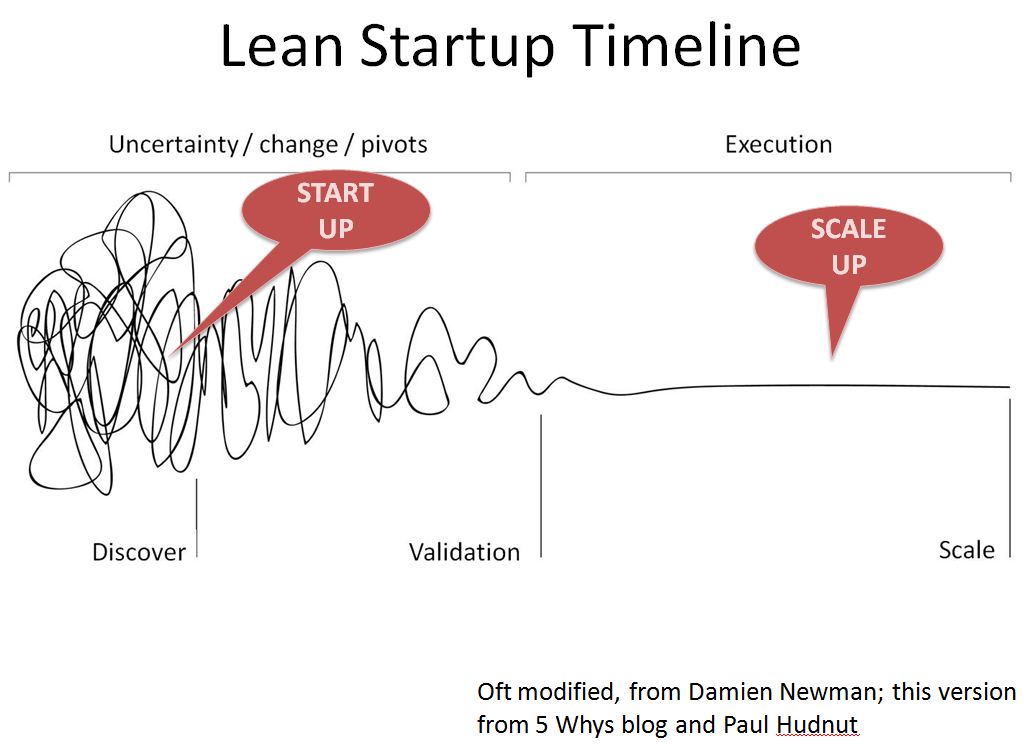
Friday, April 19, 2013
Gifted.
This post was spurred by an article about my son, Peter, who has been high lining for seven years. But these feelings can be triggered by watching anyone who does something amazing. Where you pause and marvel at their grace and apparent ease in doing something difficult. They do things that were beyond imagination a short time ago.

Too often, we use the words "blessed" or "gifted" to describe these people. I think that is a mistake, and drives self-defeating behavior. In my observation, these aren't gifts- they are the results of hard work + passion (often bordering on obsession) + other experiences (often related) they bring to bear. And imagination. Sure, some people have more genetic predilection than others, but I have lived long enough to see these comets burn out. They may get a head start, but they rarely keep their lead if they don't have these qualities. None of which are inherited, and all of which can be learned, or at least chosen.
But rather than focus on the "gifted," let's focus on how we react to them. Do they make us jealous and resentful? (I admit I have felt this way more than once.) Or competitive? Or grateful and humble? When you see them, do you give up, knowing that you will never be that good? Do they fire your competitive juices? Or do you try to learn from them, hoping that they can help you perform better, even if you never reach their heights?
Next time you find yourself thinking that someone is gifted (your friend, competitor, colleague or kid), think about how hard they must have worked to make it look so easy. These talented people can inspire you to try harder, or provide the reality test that you may be better suited to other work.
The real gift of the "gifted" is that they can make you better, either at what they and you do, or at something entirely different. Perhaps, their gift will help you find the last piece of the puzzle that you need. The ease and power of an athlete, the use of color and space by an artist, the use of dissonance and improvisation by the musician, the surprising story of a writer.
So, what would you want to be gifted in? And how are you going to do that? Who should you read... watch... listen to... talk to? What is their gift to you? How will you use it?
And who might that help?
Thursday, April 18, 2013
Salvation Through Redemption?
What follows below is an ill formed idea. It has been sitting in my brain for a while, and doesn't seem to be getting any better with age (some ideas do). So it is time to throw it out there and see what my bleeps think.
Something has been bothering me about impact investing: what if, in the end, it doesn't matter?
As a field, we are spending a lot of time now defining who is a worthy social entrepreneur, determining how to best measure impact and trying to attract funds to this emerging sector. Excitement is high. And yet... to continue a somewhat imperfect metaphor... what if we are covering the tuition and fees for a brilliant student doing a combined degree in social work, environmental science, and international development, only to see them take a job with a Wall St bank when they graduate? And, even worse, what if the way we are supporting them drives them to have to take such a job? Does the way we fund social enterprises doom them to mission drift as they grow up?
As I have pointed out in previous blogs, some of the things that drive financial investment may create a tension with impact. Like seeking liquidity (or "exit"). If a company is financed by impact investors, who also desire to get their money back at some point,* it will likely be taken public or acquired. When that happens, its new owners are likely to care less about its mission than those impact investors. And this is likely to occur when the company really starts to reach scale and sustainability. So, Social Enterprise X (what an appealing acronym) experiments and pivots its way to a solid business model. Revenues grow, and profits arrive. They have reached the promised land of social enterprise. Except their investors want their money back. As a friend and mentor said to me last week, "perhaps liquidity is the original sin of impact investing."
My pessimism lifted this past fall as I worked on a transaction where, instead of an IPO or an acquisition, liquidity was obtained for New Belgium Brewing's founders and other owners through an ESOP buyout. Here, there was a stronger chance of mission perpetuation over the long term, as the mission rested with the employees who got the business to where it was, and who believed strongly in its mission and values. A chance for legacy, as well as liquidity.
Yet New Belgium had financed its growth through bootstrapping and debt, not equity. In a conversation with Ross Baird a few weeks ago, he asked me about how we might design in, from the beginning, a structure that could allow entrepreneurs to use equity and still not "sell out" their mission as they grew. Ross cares deeply about this issue, as his firm, Village Capital, is supporting young social enterprises around the world. If the answer was "it doesn't work if you take outside equity", then it wasn't an acceptable answer for Ross. Over the course of a few golf holes and then a few beers, an idea emerged.
Staying at a fairly high level, and trying to keep the math easy, it goes like this:
1) Entrepreneurs could build in an option into all funding rounds that would allow them to redeem** their shares for specific types of transactions that would provide long term mission perpetuation (for instance, full ESOP buy out, or conversion to a cooperative).
2) Investors would agree to a price for that option equivalent to an enterprise value based on a multiple of EBITDA (or cash flow) that would allow for the company to borrow enough money to pay off the investors. This would not work for investors seeking solely financial returns, but could work for those interested in a blend of return and impact.
3) This would not prevent a company from deciding to go public, or be acquired by a larger firm. But it would allow a successful and profitable company to pursue a different path. All involved would take a lower price than might be available for a more traditional liquidity event; but they would also have the satisfaction of seeing the enterprise continue on the impact path which they originally supported.
What might these multiples need to be? Well known venture investor, Sir Ronald Cohen has written that he thinks that funds will flow into impact investments if the returns were "around 7%." And I have met with PE firms that are willing to structure equity deals with repurchase obligations based on EBITDA multiples. Earlier rounds might have to be at higher multiples (to deal with the longer time frames and greater patience of their capital). But in round numbers, if a company has strong cash flows and reasonable margins, it could redeem its investors at 6-10x EBITDA multiples, and cover the debt required to finance such a repurchase. For investors, this should represent a return on "winners" (though not the legendary 10x) sufficient to drive a 7% or more return across an impact investment portfolio.
Perhaps, through the broader use of such redemption clauses (and/or other innovations), salvation is possible for impact investing. If we can't solve the puzzle of liquidity and legacy, I fail to see how the sector will truly differentiate itself from traditional venture investing or how it will ever live up to its claims of addressing the world's biggest challenges.
So, bleeps, what do you think? If you are an investor, would you agree to such a redemption right? If you are an entrepreneur, would you find this interesting (remember, you would get less $$ too)? And for my academic friends, have I forgotten the second law of something or other? Fire away....
___________________
If you have read this far, you may want to keep reading my prior post Kickstarter and Long Shadows.
* is any capital infinitely patient? should it be?
**Bruce Campbell has advocated that redemption clauses offer an exit alternative, and should be more common in impact investments.
Tuesday, March 19, 2013
Kickstarter and Long Shadows
I have mentioned in the past the "long shadow" that funding decisions cast into the future of a startup. These decisions often set an irrevocable path for startups, one that new founders often don't understand until they have lived through it once. It happens to many entrepreneurs, with perhaps Steve Jobs being the best know example of being dumped by the company he co-founded. But it isn't just the risk of being fired that should concern the entrepreneur. They should also be concerned about the mission of the company. To reframe, it isn't about you, it is about the ability of the company to perpetuate its purpose. Good founders understand that it isn't the funding that matters, it's the funders. More specifically, their values, expectations and commitments.
These values, expectations and commitments will largely revolve around recouping the investment and a return. That is what investors do. If they put money in, at some point they will want to get it back, plus a return. While they may appreciate the purposes set by the founders and see these as fundamental to building value, those are not the primary purpose of the funders. In the end, it is about harvesting their share of the value. If it is a fund, they are required to do this, usually within 10 years of accepting money from their investors. Don't get me wrong, good investors work hard to increase the value of the firm- serving on boards, helping recruit talent, helping forge partnerships. But they are doing it so they get their money back. Even in impact investing, they are investors. If they don't want their money back, they are philanthropists, not impact investors.
I was thinking about this as I read today's Fast Company article about Kickstarter, and a great series of recent blogs by Rafe Furst on "Why Crowdfunding Changes Everything." In the Fast Company article, one of the co-founders, Perry Chen, states "This is a founder-controlled company. Our investors understand that we want to stay independent forever. We have no intention of selling this company or doing an IPO." This is interesting, given that their venture round was led by Union Square Ventures, Fred Wilson's firm. Yep, the Fred Wilson who wrote a few years ago about the need for alternatives to acquisitions and IPOs to provide liquidity for founders and investors. His main concern was the tailing off of innovation in these firms after these events. But lurking between the lines of his post was the concern that, by investing (which requires liquidity at some point) he is part of the problem. His investment, in effect, will eventually lead his most successful portfolio companies to do something that will reduce their innovation, and by necessity, their value.
The Fast Company article goes on to say that the investors accepted a requirement to "never sell their shares." Let's peel that back a bit. That means, as Chen said, that company sale and IPO are non-starters. It also seems to rule out Fred Wilson's idea of an alternative market where Union Square could sell their shares, but allow Kickstarter to remain private and independent. I'd have to speculate that the options for the investors are either that Kickstarter eventually pays a dividend (and that would need to be at a high rate to meet VC ROI requirements during the term of their fund), or that there is some repurchase formula, where the company could recapitalize and buy-out its outside investors. My guess is that it is the latter, and that will mean Kickstarter ends up with a lot of debt, or a private equity investor. Either will change Mr. Chen's life significantly, I'd wager.
Another potential path besides the "never sell out" path is exemplified by Facebook. They did go public. But the founder, Mark Zuckerberg, maintained control by issuing two classes of stock. One class retains voting control with the founders. He borrowed this idea from Google, and LinkedIn, Zynga and others have also done it. As James Surowiecki wrote in the New Yorker, "whereas the CEOs of most public companies have to spend time kowtowing to investors, Zuckerberg and his peers are insisting on the right to say 'Thanks for your money. Now shut up.'" Perhaps these choices were made to avoid Steve Jobs's fate. Or perhaps they were made to see if the company can maintain an innovative, risk tolerant culture. To maintain the option to perpetuate the company's purpose.
The road is littered with companies that lost their purpose (or at least shifted their mission away from social and environmental aspects) as they grew and needed to meet investor requirements. Ben & Jerry's, Tom's of Maine, Burt's Bees, Honest Tea. Too often, mission driven companies get bitten by their shadow. The naivete that makes one take on the world with a risky venture is often accompanied by the Achille's heel of lack of knowledge of the implications of early decisions. The entrepreneur raises money to grow and increase their impact and brand, but in the end, the cost of that capital is a loss of their core mission. Valuation trumped values. But not always, and not forever. Ben & Jerry's recently became a B Corporation. Zappo's culture continues to thrive. Stoneyfield Farms seems to have kept most of its mission intact.
As I wrote several months ago, at New Belgium, we have tried a path of 100% employee ownership to perpetuate the company mission for the long term, and were able to provide the founders with liquidity over time. However, I don't think this would have been likely if the company had raised outside equity in the early days.
If companies want to retain the ability to pursue their purpose, they will need to make intentional decisions on funding and funders. For some, it may be better to bootstrap, and grow more slowly than would be possible with outside capital. Others will use debt (carefully). Others may choose a non-profit structure (although this isn't immune from mission shift), or investigate alternative structures like the ESOP or cooperatives where customers, employees or producers are the owners (REI, Namaste Solar, Organic Valley). Others may find, as Kickstarter has, funders willing to invest patient capital. And others will invent a new way, based on the disruption that Kickstarter and their ilk have brought.
All in all, the funding process should become more democratic and transparent, and that means the shadows should get shorter and less mysterious for entrepreneurs.
Sunday, March 10, 2013
Billions Saved (not "touched")
The field I work in is obsessed with impact. How will an organization make a measurable difference on a problem that matters? Unfortunately, this sometimes leads to silly math. Claims of "lives touched," whatever that means.
Sometimes, it is useful to step back and think about those that truly had an impact. Rather than lives touched, let's talk about lives saved. Here are a few examples.
Ignaz Semmelweis - first person to worry about germs in hospitals, when he noticed the number of women dying after childbirth. Turns out doctors weren't washing their hands. This was over a hundred years ago, so problem solved, right? Sadly, no. Hand washing and disinfection, (or lack thereof) is back in news with recent CDC "super bug" warnings. Semmelweis did not live to see the triumph of his ideas. He died after being beaten by guards in an asylum.
Norman Borlaug, who was central to the green revolution in agriculture. He won the Nobel Prize, and is credited with saving a billion lives.
Edward Jenner, often called the father of immunology. He was a pioneer in inoculation and vaccination, and is credited with proving effectiveness of early small pox vaccine. Historically, it had a 30% fatality rate, and millions were infected. Centuries later, smallpox was eradicated in the early 1970's by the WHO.
Alexander Fleming discovered penicillin, which led to broad use of antibiotics to treat disease. He also won the Nobel Prize. Not every dose saved a life, but many did. And we use a lot of antibiotics these days... estimates are 190 million per day. Which causes other problems. (This is an example of over-adoption of an innovation.)
What can we learn from these examples of impact? Bake your impact into your products and services. An ounce of prevention is worth at least a pound of cure. Measure real impact. Tie your metrics to your purpose. Income produced. Acres farmed with organic methods or reforested. Cases treated. Births without HIV infection. Lives saved.
Direct causation (or correlation) is often hard to establish when you work on prevention, but work toward it, not away from it. Impact is too important to dilute with silly math and a meaningless competition on "lives touched."
_______
If you like big numbers, you might be interested in these other blogs of mine: 3 Billion Served and Logistics, Legacy and Large Numbers
Of note, if you want to save billion of lives, you are living at the right time. For a few reasons. First, many people are living now versus the past (Banks estimates "about one person of fifteen who have ever lived is currently living"). And the pace of innovation and dissemination is much higher than in the past.
Thursday, March 07, 2013
What Will "College Town" Mean in 2025?
Fort Collins is proud of its recent ranking as a top "college town." Recently, I have been wondering what a "college town" will look like in 2025, so the article in our local paper provoked this short post.
I have blogged about this before- education (including higher education) is being disrupted. I don't know how this will evolve, but wonder if Fort Collins and other cities on this list are thinking about the second half of Schumpeter's creative destruction? What will a city need to do to attract creative, innovative people and organizations, if students get their education through online courses, tapping into any class... any where... any time?
I have been trying to follow and study this trend. So far, it is the universities that are thinking most about this, and they are thinking about it mostly as a technology/marketing problem. I think they should also consider it as a business model problem. The universities (including those with faculty that teach about disruptive innovation) are acting like the incumbents they are, hoping that change happens slowly and gradually and that they can maintain their market position (and tenure). They don't seem to be thinking about what a university will look like when the students don't live here anymore. What about libraries, dorms, and yes, football stadiums (yes, my dear, that is correct plural)? Where should universities be investing? And what about faculty? Or selective admissions?
It seems that many beyond universities should be thinking about this too. What about the communities they serve? Or the businesses that serve student populations or hire university graduates? Are they thinking about what will change if the students don't live in college towns anymore? Not yet.

Friday, March 01, 2013
How to mentor someone
To mentor someone and help them achieve something worthy:
1) Understand who they are, and what makes them itch
2) Support them to unreasonable lengths
3) Challenge them to demonstrate what they really can be/do
4) Help them surprise themselves.
This is my opinion. No facts support this post.
By the way, this is also good advice for how to love someone.
Friday, January 25, 2013
This Is What Disruption Looks Like, Part III
This is cool: Y Combinator just funded its first non-profit, Watsi.
This is cooler: Paul Graham says "I've never been so excited about anything we've funded."
The startup world just shifted a bit.
This is the type of confluence between social entrepreneurship and the startup world I have been hoping for... for a long time. Great to see YC acting on the ideas from Graham's "Be Good" essay from a few years ago.

Others with similar models? Kiva and Vittana have worked in this direction for years, and Watsi's interface looks familiar. Some parallels to Global Giving and Indiegogo, too.
This is coolest: To see a growing number of crowdfunding applications that are built off of Mother Theresa's insight that "If I look at the mass, I will never act. If I look at the one, I will."
_______________
This Is What Disruption Looks Like, Part I
This Is What Disruption Looks Like, Part II
WSJ article from 1/28 entitled: "Non-profit Startups Are Just Like Their Counterparts." I don't agree. Guess that will be a future post.
Update: Watsi was featured in the NY Times on 4/13/13
Tuesday, January 15, 2013
LBO: Liquidity, Legacy, Exit 2.X
It's a thorny issue. An entrepreneurial team builds a company with a great products, an iconic brand and strong vision, values and mission. In the process of doing so, they create value. Lots of it. They finally see a pot of money at the end of the rainbow. It is a just reward for years of hard work, long hours, and ever present fear of failure. Liquidity beckons.
Typically, there are two solutions for this fortunate business: to sell all the company (acquisition) or part of it (IPO, etc.). And that's the rub. In both of those cases, you will likely lose what it is that got you there. Because along with all that hard work, long hours and fear of failure came the joy of building something different, the relationships forged in tough times together, the fun of celebrating the wins along the way. Some entrepreneurs are happy with these two choices, cash out, and then look for their next adventure. But others find this choice perplexing. Is there another way? Is there a way for the entrepreneurs to receive a fair price for the value they have created, yet not give up the soul of the company? Legacy beckons.
Which of these divergent paths to take?
This is a big issue for two reasons. First, if the only exit paths are financially driven, then the implications for mission driven companies are discouraging. There are some well known sales of mission driven companies: Ben & Jerry's sale to Unilever, Tom's of Maine to Colgate-Palmolive, Burt's Bees to Chlorox and Seventh Generation to, well, that's a whole 'nother story. But it is hard to find models of successful exits, if your yardstick has any dimensions beyond shareholder return. Some noble intentions, but little long term success and happiness on both sides of the table. The role models for exit version 2.x are limited to piecing together the "best of" components of deals that have come before.
Second, looking over the horizon, there are many more transactions to come. As Marjorie Kelly notes, "the moment of Founder Departure is about to occur on a massive scale," with the pending retirement of baby boomer entrepreneurs. She reports that while 50,000 companies changed hands in 2001, that number had shot to 750,000 by 2009, and was expected to continue to grow as boomers age.*
Figuring out alternative paths to exit matters.
There are several intriguing alternatives out there. Paths less travelled, but paths with a destination of long lasting legacy. There are ESOPs, where employees own all or part of the company in a trust for their retirement. These are used by some pretty big companies, like Publix with over 150,000 employees. A few years ago, the founder of Bob's Red Mill used this structure to give his company to his employees for his 81st birthday. In her book, Kelly describes other possibilities for "mission-controlled" companies, too- such as foundation controlled corporations (Novo Nordisk) or supplier controlled cooperatives (Organic Valley).
Becoming a B Corp (or benefit corporation), is another piece of the puzzle. All companies can seek to be certified by meeting social/environmental performance goals and transparency standards. Some notable B Corps are Patagonia, Method, Etsy, and recently, the aforementioned Ben & Jerry's. Now, the legal status of a benefit corporation is available to companies in 12 states, and more, including Colorado, are on the way.
Two companies that have combined these- 100% employed owned and B Corp certified- are King Arthur Flour and Dansko.** The reason for this rare combination was well stated by Dansko co-founder and CEO Mandy Cabot:
“Dansko is our baby; our employees are our family. Becoming an employee-owned B Corp protects our legacy, ensuring that we can not only remain independent, but also maintain our focus on being a great place to work, a valued member of our community, and a good steward of the environment.”***At New Belgium Brewing, the company faced the liquidity/legacy quandary. By building a strong brand in a growing business, the company had created great financial value. While already an employee owned company, the ownership was split with the ESOP owning a minority of the company, and the founders and executives owning the majority, and over time this was creating some pressures with respect to newer employees joining the ESOP. As a board, we struggled with the issue of unlocking the value that had been created, without sacrificing the values that had driven it or the future of our co-workers.
At the end of last year, we took the plunge, and joined the small ranks of companies that are fully employee owned B Corps. We announced the change of ownership at yesterday's all staff meeting in Fort Collins. You can get more details here. Basically, the company borrowed enough money to pay the shareholders a fair price for their shares, and the ESOP ended up owning 100% of the outstanding shares. An LBO of sorts- but rather than a Leveraged Buy Out on Wall Street, it is a Legacy Buy-Onward on Linden Street.
We kicked off the meeting with a talk by Jack Stack, whose book The Great Game of Business, had helped shape New Belgium's high involvement culture and open book management. Kim Jordan, co-founder and CEO, then took the stage. Employees were handed an envelope and a beer (hey, it is New Belgium, and it was past beer-thirty). Kim said she had struggled with issues of ownership for some time and had decided to sell control of the company. Co-workers were invited to open the envelope to find the identity of the buyer. Inside was a congratulatory message from all the selling shareholders, and a mirror. The mirror showed every co-worker that THEY were the buyer. It got a bit wild after that! When things settled down, there were some great comments by a few other members of the management team, and our ESOP trustee. Kim then assured the crowd of her continued high involvement in the company, and closed with the following:
"We have been on a long journey to look at a number of options for ownership, with a focus on who would best perpetuate what has been started, and innovate as we grow. We looked at alliances, going public and being acquired. In the end, we felt that the best people in the world to take the business forward were the ones who had taken it to this point: our co-workers. It is with great confidence that we start this next chapter in the New Belgium story, one that we all get a hand in writing."At New Belgium, we have made a deliberate decision to keep ownership in the hands of people we know and trust as a way to achieve liquidity and pursue legacy. We don't know how it will all turn out, and whether this is a path that will work for other companies. We hope so, and we will work to share our experiences with those that are interested in looking down alternative paths. Perhaps others will join us, or follow us, and these paths will become smoother, more obvious and better traveled.
We celebrated last night, and resume the journey today. It is on the path less travelled, and we hope that will make "all the difference." ****
__________________
NOTE: for my less regular readers, I have been on the New Belgium board since 2006.
* Kelly, "Owning Our Future" (2012) p 174.
** Another intriguing model is the worker cooperative B Corp from our Colorado neighbor Namaste Solar.
*** Gilbert & El Tahch, " 'B' A Better ESOP" (2012)
**** Robert Frost, "The Road Not Taken" (1920)

